Where to Buy Aged Domains in 2026: 6 Sources Ranked
Where to Buy Aged Domains in 2026: 6 Sources Ranked
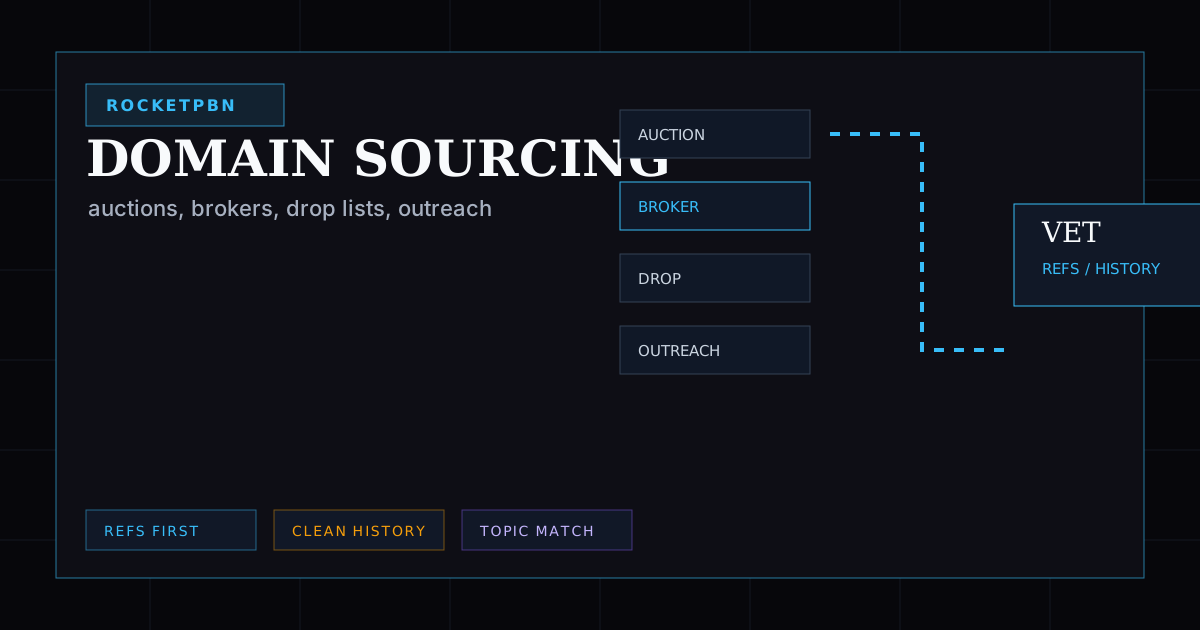
The best place to buy aged domains depends on your operating model. If you have time, tooling, and domain-vetting skill, auctions and drop lists can produce good buys. If you need deployable PBN inventory quickly, a pre-vetted broker or private marketplace usually saves more money than it costs.
The trap is treating "aged domain" as a single product. A sports domain with 80 real referring domains, clean editorial links, stable Trust Flow, and continuous Wayback history is not comparable to a domain whose headline metric was inflated by temporary links or rebuilt through three unrelated niches. The source matters because the source determines how much vetting work still sits on your side of the transaction.
This guide ranks six aged-domain sources by quality, speed, cost, vetting burden, and fit for PBN operators. It also explains what to check before payment, what price ranges are normal by referring-domain quality and trust tier, and when it makes sense to pay a premium for pre-vetted inventory.
Where Should Serious SEO Operators Buy Aged Domains?
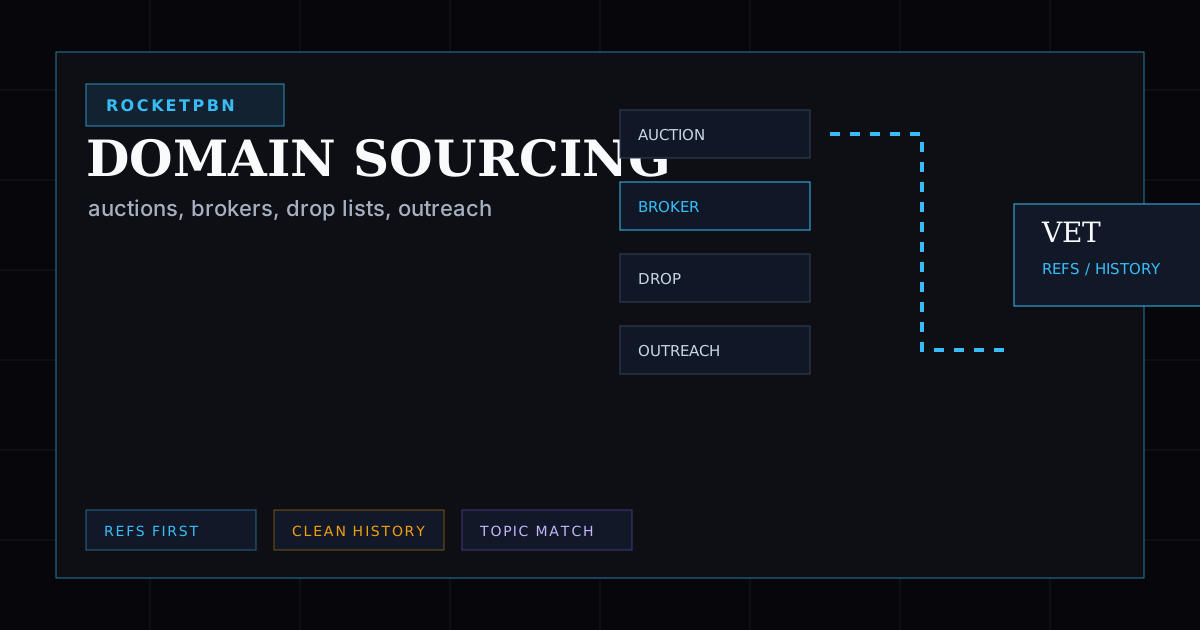
Serious SEO operators should buy aged domains from the source that matches their vetting capacity. Auctions offer breadth, drop lists offer volume, outreach offers occasional bargains, and private brokers offer speed. For PBN deployment, pre-vetted marketplaces usually have the best time-to-confidence ratio.
Quick Ranking
| Rank | Source | Best for | Cost level | Vetting burden | Speed |
|---|---|---|---|---|---|
| 1 | Pre-vetted brokers and private marketplaces | operators who need deployable inventory | medium to high | low to medium | fast |
| 2 | GoDaddy Auctions / NameJet / Sedo | buyers with strong vetting workflow | market price | high | medium |
| 3 | SpamZilla / DomCop filtered lists | volume researchers | low to medium | very high | medium |
| 4 | ExpiredDomains.net manual scraping | budget sourcing | low | very high | slow |
| 5 | Direct outreach to dormant sites | unique assets | variable | high | slow |
| 6 | Generic marketplace listings | brand names or speculation | variable | very high | medium |
The ranking favors SEO deployment, not brand acquisition. If you are buying a memorable brand name, a generic marketplace can be fine. If you are buying authority for PBN or link-building use, history, backlinks, anchors, and topical fit matter more than the name.
What "Aged" Should Mean
An aged domain is valuable only when age is paired with durable signals:
- Real backlinks from relevant referring domains.
- Continuous or explainable historical content.
- Stable DR/DA/TF metrics.
- Clean anchor text.
- No obvious spam, adult, pharma, payday, or security-abuse history.
- A previous topic that can support the new use case.
A domain can be old and still useless. A ten-year-old domain with no meaningful referring domains is just an old registration. A three-year-old domain with clean sports links may be more valuable for an restricted-niche campaign.
How Do Auctions Compare With Private Domain Brokers?
Auctions give you broad inventory at market-clearing prices, but the buyer carries the vetting burden. Private brokers cost more per domain, but they reduce research time, reject weak candidates before listing, and are usually better for operators who need domains ready for campaign planning.
Auction Platforms
GoDaddy Auctions, NameJet, Sedo, SnapNames, and DropCatch can surface strong aged domains. The advantage is supply. You can monitor hundreds of candidates across different niches, TLDs, and price ranges. The disadvantage is time pressure. Bids close quickly, and every buyer sees many of the same metrics.
Auction buying works when you already have a checklist:
- Screen DR, TF, referring domains, and price.
- Check Ahrefs for link spikes, anchors, and live referring pages.
- Check Majestic for TF:CF and Topical Trust Flow.
- Check Wayback for continuous history and niche continuity.
- Search the domain for index and reputation signals.
- Set a maximum bid before the auction heats up.
If you do not have that process, auctions are expensive training.
Private Brokers and Pre-Vetted Marketplaces
Private brokers and pre-vetted marketplaces are better when speed and confidence matter. The buyer pays for sourcing, filtering, manual checks, and curation. The premium is justified when it saves hours of review or prevents one bad purchase.
For a PBN operator buying two to five domains per month, the broker premium often beats a do-it-yourself process. Four hours of vetting per candidate adds up quickly, especially when most raw candidates fail on history, anchors, or topical fit.
Auction vs Broker Decision Table
| Situation | Better source | Why |
|---|---|---|
| You need one clean restricted-niche-relevant domain this week | broker | speed and lower vetting burden |
| You buy 20+ domains per month and have tooling | auctions / drop lists | scale can justify labor |
| You need a very specific old brand name | outreach / marketplace | backlink quality may be secondary |
| You are new to expired-domain vetting | broker | fewer expensive mistakes |
| You need bargain inventory for testing | filtered drop lists | high volume, low acquisition cost |
For RocketPBN's buyer profile, the usual path is simple: use auctions and tools for research if you have time; use pre-vetted aged domain inventory when deployment speed matters.
What Should Buyers Expect From Drop-Catching and Scraped Lists?
Drop-catching and scraped lists can produce underpriced domains, but the hit rate is low. They are research channels, not quality guarantees. Most candidates that pass first filters still fail manual review on history, anchor text, topical mismatch, spam signals, or weak referring domains.
Drop-Catching Services
Drop-catching platforms attempt to register a domain the moment it becomes available. If multiple buyers backorder the same domain, it usually goes to private auction. If you are the only buyer, you may get the domain cheaply.
The upside is price. The downside is unpredictability. Good domains attract competition, and low-competition domains are often low-quality for a reason. Treat every successful catch as a candidate, not an approved asset.
Filtered Tool Lists
Tools such as SpamZilla, DomCop, and ExpiredDomains.net help reduce the universe of expired domains. A starting filter might include:
| Filter | Conservative floor | Why it matters |
|---|---|---|
| Domain age | 3+ years | avoids very thin histories |
| DR | 25+ for tier 2, 35+ for tier 1 review | screens scale |
| Trust Flow | 10+ minimum, 18+ preferred | screens quality |
| TF:CF ratio | 0.4+ minimum, 0.5+ preferred | flags spam volume |
| Referring domains | 15+ real domains | reduces single-link dependence |
| Spam score | low or explainable | screens obvious risk |
These filters do not approve a purchase. They only create a shortlist for manual review.
Why Hit Rate Is Low
From a list of 300 filtered expired domains, an experienced operator may find 5-20 worth deeper review and 1-5 worth buying. The rest fail for predictable reasons:
- The links are no longer live.
- DR is inflated by weak or temporary links.
- Wayback shows unrelated topic flips.
- Anchors are polluted by spam verticals.
- The domain has no clean topical story.
- Referring domains are foreign-language or irrelevant to the target market.
- The seller is pricing on DR alone.
The lower purchase price hides the labor cost. If your workflow cannot process candidates quickly, cheap lists become expensive.
What Price Ranges Are Normal by Referring-Domain Quality and Trust Tier?
Aged-domain pricing should follow referring-domain quality, trust, topical fit, and scarcity. DR can help with first-pass filtering, but live referring domains, Trust Flow, Wayback history, and niche relevance decide whether the price is justified. restricted-niche, finance, and health-relevant backlink profiles command premiums.
Practical Price Ranges
Use these as planning ranges, not fixed market prices.
| Tier | Typical metrics | Normal price range | Best use |
|---|---|---|---|
| Budget test | 15-30 usable referring domains, TF 8-15 | $50-$150 | tier 2 support, experiments |
| Entry tier 1 | 30-60 usable referring domains, TF 12-20 | $150-$350 | moderate PBN support |
| Strong tier 1 | 60-120 usable referring domains, TF 18-28 | $350-$800 | direct campaign support |
| Premium | 120+ usable referring domains, TF 22-35 | $800-$1,800 | competitive niches |
| Elite | rare editorial referring domains, TF 30+ | $1,800-$5,000+ | high-value campaigns |
Topical fit can move a domain above or below the table. A former sports vertical blog with fewer but cleaner referring domains can be worth more to an restricted-niche operator than a generic lifestyle domain with a larger headline metric. The inverse is also true: a domain with unrelated or contaminated history deserves a discount or rejection.
What Drives Premium Pricing
Premium domains usually have at least four of these signals:
- High percentage of live referring domains.
- Editorial links from recognizable publications.
- Relevant Topical Trust Flow.
- Continuous Wayback history.
- Clean natural anchors.
- No long parking or spam period.
- Indexed pages after rebuild.
- Commercially useful niche history.
What Should Lower the Price
Price should drop when the buyer inherits uncertainty:
- Historic TF much higher than fresh TF.
- Large link spikes in the last 90 days.
- Obvious seller-built links.
- Weak or missing Wayback snapshots.
- Mixed-language link profile for an English campaign.
- Former adult, pharma, payday, or security-abuse context.
- Exact-match anchors from an old SEO campaign.
If the seller prices only on DR, the buyer should push back with TF, history, and referring-domain evidence.
What Vetting Should Happen Before Payment?
Every aged domain should pass a manual vetting process before payment. The minimum review covers authority metrics, live referring domains, anchor text, Wayback history, index signals, topical fit, outbound link history, and price justification. Skipping history checks is where most bad purchases happen.
12-Point Buyer Checklist
| Check | Tool or method | Pass signal |
|---|---|---|
| DR and referring domains | Ahrefs | enough real domains for the price |
| TF and CF | Majestic | TF:CF above 0.4, preferably 0.5+ |
| Topical Trust Flow | Majestic | category fits target niche |
| Anchor text | Ahrefs / Majestic | branded, natural, no toxic concentration |
| Live link sample | manual open | top links still exist and make sense |
| Wayback history | Archive.org | continuous real site, no hard spam flips |
| Index status | Google search checks | no obvious deindex problem |
| Outbound links | Ahrefs linked domains / manual | no link-farm pattern |
| Language and geo | referring domains | matches target market enough |
| Recent link velocity | Ahrefs timeline | no suspicious seller-built spike |
| Trademark risk | search/manual | no obvious brand conflict |
| Price logic | compare metrics and niche | price matches deployable value |
For a deeper process, use the Expired Domain Evaluation Checklist.
History Beats Metrics
Metrics can lag. A domain can show DR 45 after links have disappeared. A domain can show decent TF while Wayback reveals two years of pharma content. A domain can show low spam score while anchor text exposes prior abuse.
History is the context that explains the numbers. If the history does not support the current price, do not buy.
Policy-Sensitive Review
Google Search Central's spam policies include expired domain abuse when an expired domain is repurposed primarily to manipulate rankings with low-value content. Google's link spam guidance also covers links created primarily to manipulate rankings. That is why aged-domain acquisition should be treated as an asset-quality decision, not a shortcut around quality.
The practical standard is clear: rebuild domains with real topical content, preserve relevance, avoid obvious link shells, and do not buy domains whose history already looks like a spam vehicle.
When Is a Pre-Vetted Marketplace Worth the Premium?
A pre-vetted marketplace is worth the premium when the buyer values speed, cleaner shortlists, and lower mistake risk more than the lowest possible acquisition cost. It is especially useful for restricted-niche, finance, and affiliate SEO campaigns where one bad domain can waste budget and delay deployment.
The Real Cost of DIY Sourcing
DIY sourcing looks cheaper because the purchase price is visible and the labor is hidden. A realistic workflow may look like this:
| Step | Time per candidate |
|---|---|
| First metric screen | 2-5 minutes |
| Ahrefs / Majestic review | 10-20 minutes |
| Wayback history review | 10-20 minutes |
| Anchor and link sample review | 10-20 minutes |
| Price and niche fit decision | 5-10 minutes |
If 20 candidates produce one buy, the labor cost can exceed the broker premium. That does not make DIY bad. It means it only works when your process is efficient.
Who Should Use a Broker First?
Use a broker or pre-vetted marketplace first if:
- You need a domain for a live campaign now.
- You are buying in a restricted niche.
- You do not have Majestic/Ahrefs workflow confidence.
- You cannot afford a long evaluation cycle.
- You need strong referring-domain profiles that are hard to source cleanly.
- You care more about deployable quality than bargain hunting.
Use auctions and tools first if:
- You are building a large inventory over time.
- You can reject 95% of candidates without hesitation.
- You already know your niche metrics.
- You have time to wait for the right asset.
RocketPBN Fit
RocketPBN fits buyers who need aged domains with strong referring-domain profiles for PBN and competitive SEO use, especially in regulated-market and regulated-adjacent campaigns. The value is not just the registration age. It is the saved research time: live referring domains, backlink history, Trust Flow, topical fit, anchors, and obvious risk signals are reviewed before the domain reaches the buyer's shortlist.
If you're running a regulated-market campaign and need aged domains with strong referring domains, clean backlink history, and niche-relevant context, browse the RocketPBN inventory ->. Pre-vetted, backlink-led, ready for operator review.
What Questions Do Aged-Domain Buyers Ask Most Often?
Is it better to buy an aged domain or register a dropped domain?
For SEO deployment, it is usually better to buy the domain with the cleaner backlink profile, not the one with the cheapest registration path. A dropped domain can be valuable if the links and history survived. A privately sold aged domain can be weak if the metrics are inflated.
Are auction domains already vetted?
No. Auction platforms may show useful metrics or demand signals, but they do not replace buyer-side review. You still need to check backlinks, anchors, Wayback history, index signals, outbound links, and topical fit before bidding seriously.
What referring-domain profile is safest for buying PBN domains?
There is no single safest range. A practical tier 1 candidate usually has enough live referring domains to avoid single-link dependence, clean anchors, acceptable Trust Flow, and a topical history that fits the campaign. DR can help sort candidates, but referring-domain quality decides whether the asset is usable.
Should I buy domains only from the same niche?
Exact niche match is best, but adjacent topical fit can work. For restricted-niche, sports, poker, racing, entertainment, review, and odds-related histories are often useful. Completely unrelated histories reduce contextual value and should lower confidence.
How many aged domains should a campaign buy first?
Start with enough domains to test impact without forcing unnatural velocity. For a small campaign, 2-5 clean tier 1 domains can be a useful first batch. Scale only after indexation, crawl, and ranking movement justify more purchases.
What Should You Read Next?
- Expired Domain Evaluation Checklist
- How to Find Expired Domains
- Expired Domains for SEO
- Domain Authority Metrics Explained
- Browse pre-vetted aged domains ->
Which Sources Inform This Guide?
Policy-sensitive sections reference Google Search Central documentation on spam policies, expired domain abuse, link spam, and qualifying paid or sponsored links. Tool-specific metric sections should be checked against current Ahrefs, Moz, and Majestic documentation before publication refreshes.